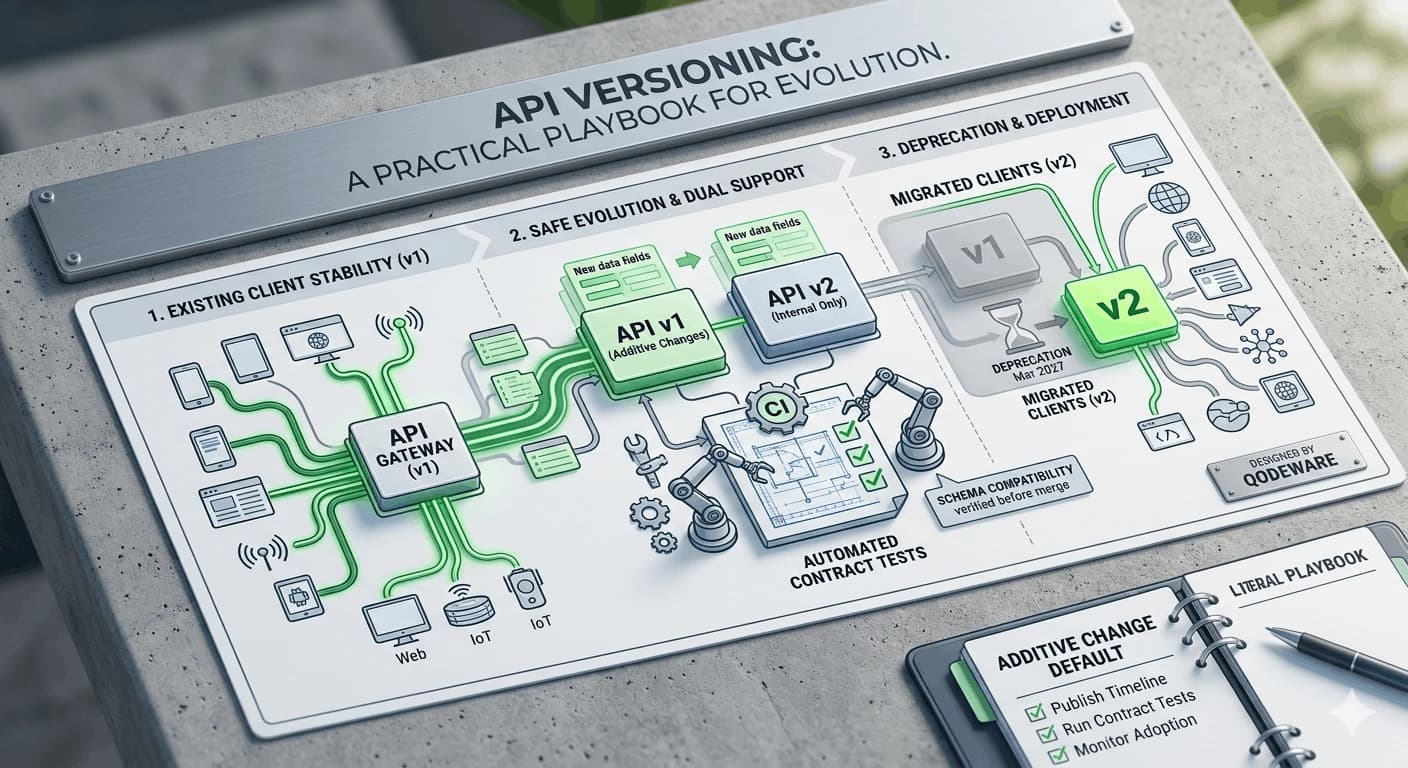
API Versioning Without Client Breakage: A Practical Playbook
A practical approach to evolving APIs safely while keeping existing clients stable and release velocity high.
Read articleA practical guide to structuring React 19 applications for predictable delivery, cleaner state flows, and faster iteration.

React teams rarely slow down because of JSX syntax. They slow down when state, ownership, and rendering responsibilities become unclear.
React 19 gives you better primitives, but shipping speed still depends on architecture discipline.
Define what must run on the client and what can stay on the server. Mixing both without intent increases complexity and debugging overhead.
Group state, validation, async calls, and components by feature slice. Avoid spreading one feature across many unrelated folders.
Use a consistent model for loading, error, empty, and success states across the app. This removes UI inconsistency and prevents repeated ad-hoc handling.
Adopt one form model and one validation strategy across the product. Mixed form patterns are one of the fastest paths to frontend drift.
Parse and validate API responses where they enter the UI layer. Invalid data should fail fast and visibly.
If you need senior product engineering support to ship faster with a stable frontend architecture, contact us or book a call.
Share this article

Michael G
Founder (Product & Engineering)
Founder-led product engineering focused on fast execution and measurable outcomes.
A practical approach to evolving APIs safely while keeping existing clients stable and release velocity high.
Read article
A practical release model for using feature flags to reduce deployment risk while keeping weekly delivery speed.
Read article
How to structure App Router projects so new features can ship quickly without routing, data, and layout complexity.
Read articleBook a focused call and we can map scope, delivery approach, and execution plan.