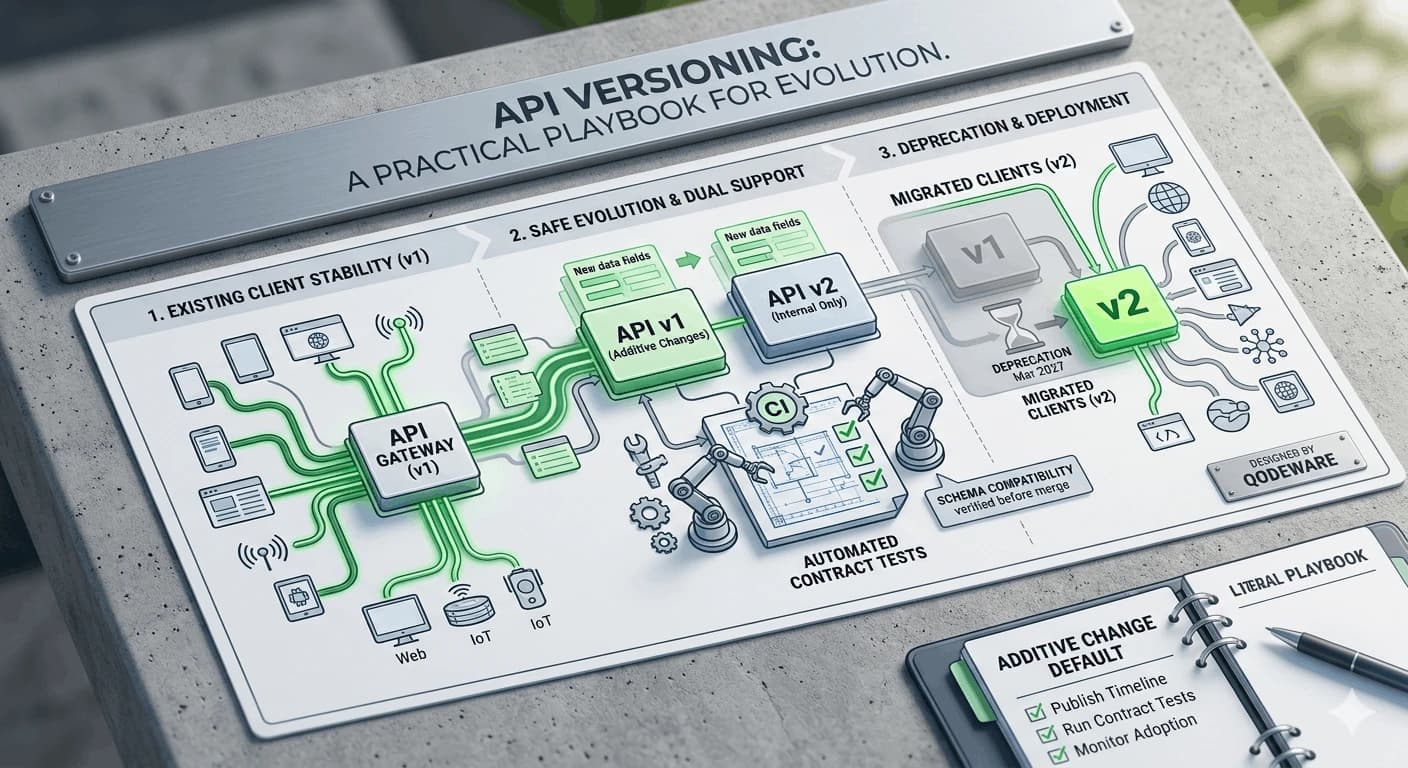
API Versioning Without Client Breakage: A Practical Playbook
A practical approach to evolving APIs safely while keeping existing clients stable and release velocity high.
Read articleA practical release model for using feature flags to reduce deployment risk while keeping weekly delivery speed.

Startups need to ship continuously, but one bad release can erase trust quickly. Feature flags create a safer release layer between deployment and user impact.
Many teams use flags only as temporary toggles. The result is stale flags, unclear ownership, and growing complexity.
Treat flags as a release discipline, not a workaround.
Each flag needs one owner and one removal date. No owner means no accountability.
Release to internal users first, then a small external segment, then full traffic after metrics hold.
Track activation rate, errors, and performance by flag state. If metrics move in the wrong direction, roll back the flag instantly.
Once a feature is stable, remove dead paths and delete the flag. Permanent flags should be rare and intentional.
If your team needs faster releases with lower production risk, contact us or book a call.
Share this article

Michael G
Founder (Product & Engineering)
Founder-led product engineering focused on fast execution and measurable outcomes.
A practical approach to evolving APIs safely while keeping existing clients stable and release velocity high.
Read article
A practical guide to structuring React 19 applications for predictable delivery, cleaner state flows, and faster iteration.
Read articleBook a focused call and we can map scope, delivery approach, and execution plan.